usb connector types chart pdf

USB Connector Types Chart: A Comprehensive Guide (2026)
Navigating the diverse world of USB connectors requires a detailed chart‚ especially in 2026‚ with evolving standards and numerous cable options available to consumers today.
The Universal Serial Bus (USB) has revolutionized how devices connect and communicate‚ evolving from a simple peripheral interface to a ubiquitous standard powering modern technology. Initially designed to standardize the connection of computer peripherals‚ USB has expanded to encompass a vast array of devices‚ from smartphones and tablets to wearables and laptops. This proliferation has led to numerous USB standards‚ plug types‚ and speeds‚ creating a complex landscape for consumers.
Over the past decade‚ we’ve witnessed a significant shift towards USB-C‚ or USB Type-C‚ becoming the dominant interface. However‚ legacy connectors like USB Type-A and Type-B remain prevalent‚ alongside smaller form factors like Mini-USB and Micro-USB. Understanding these different standards is crucial for ensuring compatibility and optimal performance. Despite the rise of wireless charging and cloud data backups‚ physical cables remain essential for power delivery and data management.
A comprehensive USB connector types chart‚ particularly in PDF format‚ serves as an invaluable resource for navigating this complexity. These charts detail the various connector types‚ their corresponding USB generations‚ and their respective capabilities‚ aiding in informed decision-making when purchasing cables or connecting devices.
The Evolution of USB Connectors
The journey of USB connectors began with the original USB Type-A‚ a rectangular port that became synonymous with the standard. This was later joined by the USB Type-B‚ designed for larger devices like printers. As devices shrank‚ so too did the connectors‚ leading to the introduction of Mini-USB and subsequently‚ the even smaller Micro-USB‚ which dominated mobile devices for years.
However‚ the limitations of these earlier connectors – particularly their size and lack of reversibility – spurred the development of USB Type-C. This new connector aimed to address these shortcomings‚ offering a smaller‚ reversible design and supporting faster data transfer speeds and increased power delivery. The USB Promoter Group finalized the design of USB Type-C intending it to replace all current USB connectors.
A USB connector types chart‚ often available in PDF format‚ visually represents this evolution‚ showcasing the progression from larger‚ less versatile connectors to the modern‚ feature-rich USB-C. These charts highlight the key differences in physical design‚ data transfer capabilities‚ and power delivery specifications‚ providing a clear understanding of the advancements made over time.
Why a USB Connector Types Chart is Essential
In today’s tech landscape‚ a USB connector types chart‚ particularly in PDF format for easy access and portability‚ is no longer a convenience – it’s a necessity. Consumers are surrounded by devices utilizing various USB standards‚ from the legacy Type-A to the modern Type-C‚ and understanding these differences is crucial for compatibility and optimal performance.
The proliferation of USB standards‚ speeds (USB 2.0‚ 3.0‚ 3.2‚ USB4)‚ and features (Power Delivery‚ DisplayPort Alt Mode) adds to the complexity. A comprehensive chart clarifies these specifications‚ preventing the purchase of incompatible cables or adapters. It aids in identifying the correct connector for specific devices and applications‚ ensuring efficient data transfer and charging.
Furthermore‚ with the increasing density of consumer products and their growing power needs‚ selecting the appropriate USB connector and cable becomes even more critical. A well-designed chart‚ often detailing version and speed markings‚ empowers users to make informed decisions‚ maximizing the potential of their technology and avoiding frustrating compatibility issues.

Common USB Connector Types
Identifying prevalent USB connectors – Type-A‚ Type-B‚ Mini-USB‚ Micro-USB‚ and the ubiquitous Type-C – is vital‚ and a chart simplifies recognizing these forms quickly.
USB Type-A: The Original Standard
USB Type-A remains the most recognizable USB connector‚ having served as the industry standard for over two decades. A comprehensive USB connector chart PDF will invariably feature this rectangular port prominently‚ illustrating its widespread use across computers‚ peripherals‚ and chargers. It’s been a reliable bridge for data transfer and power delivery for years.
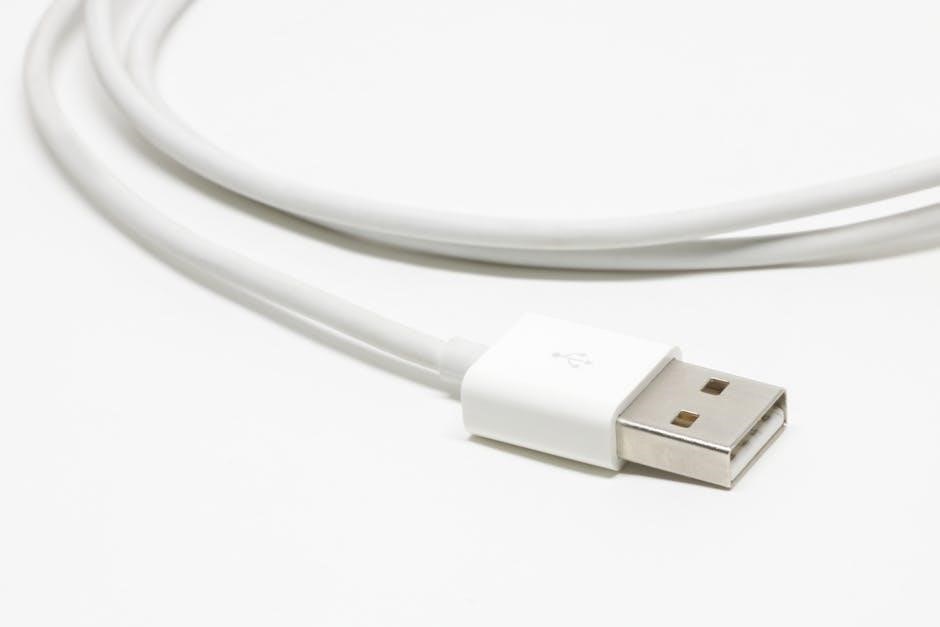
Despite the rise of USB-C‚ Type-A’s prevalence ensures its continued relevance. Charts detail its various USB generation compatibility – from USB 1.0/1.1 through 3.2 – often color-coded to indicate speed capabilities. While newer standards offer significantly faster transfer rates‚ many devices still rely on Type-A for backward compatibility.
Understanding the different USB versions supported by a Type-A port is crucial‚ and a good chart will clearly delineate these. Consumers often encounter Type-A ports in everyday devices‚ making familiarity essential. Even with wireless alternatives gaining traction‚ cables remain vital for power and data management‚ solidifying Type-A’s enduring presence.
USB Type-B: For Larger Devices
USB Type-B connectors‚ often square or slightly trapezoidal‚ traditionally found application in larger devices like printers‚ scanners‚ and external hard drives. A detailed USB connector types chart PDF will showcase the standard Type-B alongside its miniaturized versions‚ Mini-USB and Micro-USB‚ highlighting their dimensional differences. These charts often illustrate the pin configurations for each variant.
While less common in modern consumer electronics due to the shift towards USB-C‚ Type-B remains relevant in specific industrial and legacy applications. Charts will typically indicate the USB version supported by a Type-B port (e.g.‚ USB 2.0‚ USB 3.0)‚ influencing data transfer speeds. Identifying the correct Type-B variant is crucial for compatibility.
The evolution of USB saw the introduction of Mini-USB and Micro-USB as space-saving alternatives‚ but Type-B continues to serve a purpose where robustness and a secure connection are prioritized. A comprehensive chart will aid in distinguishing between these similar-looking connectors‚ preventing connection errors and ensuring proper functionality.
Mini-USB: A Smaller Form Factor
Mini-USB connectors emerged as a compact alternative to the standard USB Type-B‚ designed for portable devices where space was at a premium. A USB connector types chart PDF will visually demonstrate the size reduction compared to Type-B‚ often including precise dimensional specifications. These charts frequently detail the Mini-A and Mini-B variations‚ clarifying their differing pinouts and applications.
Initially popular in digital cameras‚ MP3 players‚ and older mobile phones‚ Mini-USB offered a more convenient connection experience for smaller gadgets. Charts will typically indicate the USB version supported (USB 2.0 being the most common)‚ impacting data transfer rates. Identifying the correct Mini-USB type is essential for proper device operation.
However‚ Mini-USB has largely been superseded by the even smaller Micro-USB and now USB-C. Despite its decline‚ understanding Mini-USB remains relevant when dealing with legacy devices. A detailed chart provides a valuable reference for recognizing and utilizing this older connector standard‚ aiding in troubleshooting and compatibility.
Micro-USB: Dominating Mobile Devices
Micro-USB rapidly became the dominant connector for mobile devices for over a decade‚ largely due to its significantly smaller size compared to Mini-USB. A comprehensive USB connector types chart PDF will clearly illustrate this size difference‚ alongside detailed pinout diagrams. These charts often highlight the Micro-A and Micro-B variations‚ with Micro-B being the most prevalent in smartphones and tablets.
Supporting USB 2.0 speeds primarily‚ Micro-USB provided reliable data transfer and charging capabilities for a wide range of devices. Charts will specify the maximum current supported‚ crucial for understanding charging speeds. Identifying Micro-USB’s limitations‚ such as its fragility and single-sided insertion‚ is also often included.

While now being phased out in favor of USB-C‚ Micro-USB remains common in older peripherals and budget devices. A well-designed chart aids in identifying Micro-USB versions and compatibility issues‚ proving invaluable when working with legacy equipment. Understanding its specifications is key for proper cable selection and device functionality.
USB Type-C: The Modern Standard
USB Type-C represents a significant leap forward in connector technology‚ quickly becoming the universal standard across numerous devices – from smartphones and laptops to wearables. A detailed USB connector types chart PDF will showcase its reversible design‚ eliminating the frustration of incorrect insertion. These charts emphasize its versatility‚ supporting multiple protocols like USB‚ DisplayPort‚ and Thunderbolt.
Beyond its physical form‚ Type-C’s capabilities are highlighted in charts‚ detailing Power Delivery (USB-PD) for faster charging and increased power output. Charts also illustrate the various data transfer speeds achievable‚ depending on the underlying USB generation (USB 3.1‚ 3.2‚ USB4); Understanding these speeds is crucial for optimal performance.
The adoption of Type-C is driven by its ability to handle increasing power demands and larger file transfers; A comprehensive chart will clarify compatibility nuances and the need for appropriate cables to unlock the full potential of Type-C devices‚ ensuring seamless connectivity.

USB Connector Speed and Generations
USB speed evolution is clearly documented in connector charts‚ detailing advancements from USB 1.0 to the latest USB4‚ showcasing increased data transfer rates over time.
USB 1.0 & 1.1: The Early Days
Initially released in 1996‚ USB 1.0 marked the beginning of a revolution in device connectivity‚ though its impact was limited by its slow data transfer speeds. USB charts from this era primarily focused on identifying the basic Type-A and Type-B connectors‚ as these were the dominant forms. The original specification offered a maximum data rate of just 1.5 Mbps (Low Speed)‚ quickly followed by USB 1.1 in 1998‚ boosting this to 12 Mbps (Full Speed).
These early USB charts were relatively simple‚ highlighting the plug types and basic functionality. They didn’t need to detail complex power delivery or alternate modes‚ as these features hadn’t yet been developed. PDF documentation at the time served as a crucial resource for manufacturers and consumers alike‚ clarifying the new standard and its potential. While significantly slower than modern USB versions‚ USB 1.0 and 1.1 laid the groundwork for the ubiquitous connectivity we rely on today‚ and early charts documented this foundational technology.
USB 2;0: A Significant Improvement
Released in 2000‚ USB 2.0 represented a substantial leap forward‚ introducing “High Speed” data transfer rates up to 480 Mbps – a forty-fold increase over USB 1.1. Consequently‚ USB connector charts began to evolve‚ detailing not only the existing Type-A and Type-B connectors but also the emerging Mini-USB‚ catering to the growing market of portable devices. PDF guides became more comprehensive‚ illustrating the differences in pinouts and capabilities between the various connector types.

These charts started to include information about backward compatibility‚ a key feature of USB 2.0‚ allowing older devices to connect to newer ports. The increased bandwidth enabled new applications like external hard drives and higher-quality webcams‚ reflected in updated documentation. USB 2.0’s widespread adoption meant that connector charts became essential for both consumers and manufacturers‚ ensuring proper device integration and functionality. The PDF format proved ideal for distributing detailed technical specifications and visual guides.
USB 3.0 / 3.1 Gen 1 / 3.2 Gen 1: SuperSpeed USB
The introduction of USB 3.0 in 2008‚ later rebranded as USB 3.1 Gen 1 and USB 3.2 Gen 1‚ marked another significant performance boost‚ achieving speeds up to 5 Gbps. USB connector charts rapidly adapted‚ visually distinguishing these “SuperSpeed” ports‚ often by a blue color-coding. PDF documentation became crucial for identifying compatible devices and understanding the new connector specifications.
These charts detailed the addition of new pins within the USB Type-A connector to accommodate the increased bandwidth. The complexity grew‚ necessitating clearer visual representations in PDF format to avoid confusion. Charts also began to highlight the power delivery capabilities of USB 3.0‚ essential for powering larger devices. As naming conventions evolved (3.1 Gen 1 to 3.2 Gen 1)‚ updated charts were vital to maintain clarity for consumers and professionals alike‚ ensuring accurate device selection and optimal performance.

USB 3.1 Gen 2 / 3.2 Gen 2: SuperSpeed+ USB
Building upon the foundation of SuperSpeed USB‚ USB 3.1 Gen 2 (later USB 3.2 Gen 2) doubled the data transfer rate to 10 Gbps. Consequently‚ USB connector type charts needed to clearly differentiate these “SuperSpeed+” ports‚ often utilizing distinct markings alongside the blue color. PDF guides became essential for deciphering the increasingly complex landscape of USB standards.
These charts detailed the encoding schemes employed to achieve the higher speeds‚ and highlighted compatibility considerations with older USB versions. The PDF format allowed for detailed pinout diagrams and technical specifications. As with previous iterations‚ accurate charts were crucial for consumers to verify device compatibility and maximize performance. The renaming to USB 3.2 Gen 2 further emphasized the need for updated‚ comprehensive charts to avoid confusion‚ especially regarding power delivery capabilities and alternate mode support.
USB 3.2 Gen 2×2: Even Faster Data Transfer
Representing a significant leap forward‚ USB 3.2 Gen 2×2 achieves a remarkable 20 Gbps data transfer rate by utilizing two lanes of 10 Gbps operation. USB connector type charts‚ particularly in PDF format‚ became vital for illustrating this dual-lane architecture and its implications for compatible devices. These charts needed to clearly indicate which hosts and devices supported this standard‚ as it requires specific hardware implementation.
PDF guides detailed the necessary cabling – typically USB-C – to support 20 Gbps speeds‚ and highlighted potential limitations with older cables. Understanding the power delivery capabilities alongside the increased bandwidth was also crucial‚ and well-documented in these charts. Accurate identification of Gen 2×2 ports‚ often through specific markings‚ was paramount for consumers. The complexity of USB 3;2 necessitated comprehensive‚ easily accessible charts to navigate the evolving landscape of data transfer technologies.
USB4: Leveraging Thunderbolt Technology
USB4 marked a pivotal shift‚ incorporating Thunderbolt protocol to deliver speeds up to 40 Gbps. USB connector type charts in PDF format became essential for deciphering the nuances of USB4‚ as it offered backward compatibility with older USB versions and Thunderbolt 3. These charts detailed the required USB-C connector and clarified the different operational modes – including data‚ display‚ and power delivery.
PDF guides highlighted the importance of verifying Thunderbolt support‚ as not all USB4 ports fully implemented the Thunderbolt protocol. Charts visually represented the tunneling of various protocols within USB4‚ showcasing its versatility. Understanding the impact on external displays and high-speed storage devices was crucial‚ and clearly outlined in these resources. Accurate identification of USB4 features‚ including Power Delivery revisions‚ was vital for consumers navigating the increasingly complex world of connectivity‚ making detailed charts indispensable.

Specialized USB Connector Types
PDF charts detail USB-C’s versatility‚ showcasing Power Delivery (USB-PD) and DisplayPort Alternate Mode (DP Alt Mode) capabilities‚ alongside Thunderbolt implementations for advanced functionality.
USB-C with Power Delivery (USB-PD)
USB Power Delivery (USB-PD) is a significant advancement detailed within comprehensive USB connector type charts‚ particularly in PDF format. These charts illustrate how USB-PD transcends traditional USB charging limitations‚ enabling much faster and more efficient power transfer. Unlike older USB standards‚ USB-PD can negotiate power levels up to 240W‚ allowing for the charging of laptops‚ monitors‚ and other power-hungry devices directly through the USB-C port.
PDF charts often include tables outlining the various USB-PD profiles‚ detailing the supported voltages and currents. They highlight the benefits of bidirectional power‚ meaning a device can both supply and receive power through the same USB-C connection. This is crucial for features like reverse charging‚ where a laptop can charge a smartphone.
Furthermore‚ these charts demonstrate how USB-PD integrates with Programmable Power Supply (PPS) technology‚ offering even finer-grained control over power delivery for optimized charging and device safety. Understanding these specifications‚ as presented in a well-structured PDF‚ is essential for consumers and professionals alike when selecting cables and power adapters.
USB-C with DisplayPort Alternate Mode (DP Alt Mode)
Detailed USB connector type charts‚ frequently available in PDF format‚ showcase the versatility of USB-C through DisplayPort Alternate Mode (DP Alt Mode). This feature allows USB-C ports to transmit DisplayPort video signals directly‚ eliminating the need for dedicated DisplayPort or HDMI ports on many devices. Charts illustrate how DP Alt Mode enables support for high resolutions‚ including 8K and beyond‚ alongside high refresh rates‚ crucial for gaming and professional applications.
PDF resources often include compatibility matrices‚ clarifying which USB-C devices and cables support DP Alt Mode. They explain the importance of verifying support‚ as not all USB-C ports are created equal. The charts also detail the maximum resolutions and refresh rates achievable based on the DisplayPort version supported (e.g.‚ DP 1.4‚ DP 2.0).
Understanding DP Alt Mode‚ as presented in these charts‚ is vital for connecting laptops‚ smartphones‚ and tablets to external displays‚ docks‚ and monitors. It streamlines connectivity and reduces cable clutter‚ making it a key feature highlighted in comprehensive USB connector guides.
Thunderbolt 3 & 4 (USB-C Based)
Comprehensive USB connector charts in PDF format meticulously detail Thunderbolt 3 and 4‚ emphasizing their foundation on the USB-C connector. These charts clarify that while utilizing the USB-C physical port‚ Thunderbolt isn’t simply a faster USB; it’s a distinct protocol offering significantly enhanced capabilities. PDF guides illustrate how Thunderbolt 3 & 4 combine PCIe‚ DisplayPort‚ and USB data transfer into a single connection.
Charts highlight the substantial bandwidth advantages – 40 Gbps for Thunderbolt 3 and potentially higher for Thunderbolt 4 – enabling support for external GPUs‚ high-speed storage‚ and multiple 4K displays. They also delineate the key differences between the two versions‚ including minimum requirements for port connectivity and feature support.
Reliable PDF resources will specify compatibility considerations‚ noting that Thunderbolt 3 ports are generally backward compatible with USB-C‚ but full Thunderbolt functionality requires certified cables and devices. Understanding these nuances‚ as presented in detailed charts‚ is crucial for maximizing performance and avoiding connectivity issues.
USB Type-A to Type-C Adapters
Detailed USB connector charts‚ often available in PDF format‚ dedicate sections to USB Type-A to Type-C adapters‚ acknowledging their crucial role in bridging legacy devices with modern technology. These charts illustrate the adapter’s function: enabling connection of older USB-A peripherals – like flash drives‚ keyboards‚ and mice – to devices featuring only USB-C ports. PDF guides emphasize that while adapters facilitate physical connection‚ data transfer speeds are limited by the slower USB-A standard.
Charts typically categorize adapters based on functionality‚ differentiating between simple data transfer adapters and those supporting USB Power Delivery (PD)‚ allowing charging of Type-C devices from a USB-A power source. Reliable resources will also address potential compatibility concerns‚ noting that not all adapters are created equal.
PDFs often include warnings about using high-quality‚ certified adapters to ensure data integrity and prevent damage to connected devices. Understanding these adapter specifications‚ as presented in comprehensive charts‚ is vital for seamless integration of older and newer technologies.
USB-B to Type-C Adapters
Comprehensive USB connector type charts in PDF format detail USB-B to Type-C adapters‚ essential for connecting older peripherals – commonly printers and some audio interfaces – to newer devices equipped solely with USB-C ports. These charts highlight the adapter’s function as a bridge‚ enabling continued use of established USB-B equipment without requiring a full device replacement.
PDF guides often categorize these adapters‚ distinguishing between adapters supporting only data transfer and those offering power delivery capabilities. Charts emphasize that USB-B is typically slower than USB-C‚ meaning data transfer speeds will be constrained by the USB-B standard‚ regardless of the adapter.
Reliable resources within these PDFs will also address potential driver compatibility issues‚ as older USB-B devices may require specific drivers to function correctly with a USB-C host. Charts frequently advise users to verify adapter quality and certification to ensure reliable performance and prevent potential damage to connected equipment.

Understanding USB Connector Charts (PDF Format)
Detailed PDF charts are crucial for deciphering USB complexities‚ offering a visual guide to connector types‚ speeds‚ and compatibility‚ aiding consumers in selecting the correct cables.
Key Information Included in a USB Chart
A comprehensive USB connector chart‚ typically found in PDF format‚ should detail several key pieces of information for effective understanding and practical application. Firstly‚ a clear visual representation of each connector type – Type-A‚ Type-B‚ Mini-USB‚ Micro-USB‚ and the increasingly prevalent Type-C – is essential. Alongside each visual‚ the chart must specify the USB generation associated with that connector‚ such as USB 2.0‚ USB 3.2‚ or USB4.
Furthermore‚ data transfer speeds corresponding to each generation (e.g.‚ 480 Mbps for USB 2.0‚ up to 40 Gbps for USB4) should be clearly indicated. Power Delivery (PD) capabilities‚ if supported by a particular connector type‚ are also vital inclusions‚ noting the maximum wattage it can handle. Charts should also differentiate between standard USB connectors and those supporting alternate modes like DisplayPort (DP Alt Mode);
Finally‚ a good chart will often include compatibility notes‚ outlining which devices typically utilize each connector‚ and potentially highlight any adapter requirements for connecting different USB types. This ensures users can quickly identify the correct cable or adapter for their specific needs‚ avoiding compatibility issues and maximizing data transfer efficiency.

Where to Find Reliable USB Connector Charts (PDF)
Locating trustworthy USB connector charts in PDF format requires careful sourcing. The official USB Implementers Forum (USB-IF) website is a primary resource‚ often providing detailed specifications and diagrams‚ though not always in a readily downloadable chart format. Reputable tech websites like How-To Geek‚ Lifewire‚ and Tom’s Hardware frequently publish or link to well-maintained charts‚ offering user-friendly explanations alongside the visuals.
Manufacturer websites‚ such as those of cable and accessory producers like Anker or Belkin‚ sometimes offer simplified charts to showcase their product compatibility. However‚ these may be biased towards their offerings. Academic institutions and engineering resource sites can also host comprehensive charts‚ geared towards a more technical audience.
When downloading‚ always verify the source’s credibility and the chart’s publication date‚ as USB standards evolve rapidly. Beware of outdated charts circulating on less reputable websites. Prioritize PDFs from recognized organizations or tech publications to ensure accuracy and avoid misinformation regarding connector types and capabilities.
Interpreting USB Version and Speed Markings
Decoding USB version and speed markings on connectors and cables‚ often found within a USB connector types chart PDF‚ is crucial for optimal performance. Look for symbols like “SS” indicating SuperSpeed (USB 3.0 or later). Numbers following “USB” denote the generation: USB 3.2 Gen 1 (formerly USB 3.0) offers up to 5Gbps‚ while USB 3.2 Gen 2 boosts this to 10Gbps. USB 3.2 Gen 2×2 doubles that again to 20Gbps.
USB4‚ leveraging Thunderbolt technology‚ can reach 40Gbps. The presence of a trident logo signifies USB 3.1 Gen 2 or 3.2 Gen 2. Power Delivery (PD) capabilities are often indicated by a lightning bolt symbol. Charts will detail these markings‚ clarifying maximum theoretical speeds.
Remember‚ these are maximum speeds; actual performance depends on the host device‚ cable quality‚ and connected peripherals. A chart will help correlate these markings with real-world expectations‚ ensuring you select the appropriate cable for your data transfer or charging needs‚ avoiding bottlenecks and maximizing efficiency.
Future Trends in USB Connector Technology
Examining future trends‚ as detailed in a comprehensive USB connector types chart PDF‚ points towards continued USB-C dominance and advancements in data transfer protocols. Expect wider adoption of USB4 Version 2.0‚ promising speeds up to 80Gbps‚ and potentially even 120Gbps‚ significantly exceeding current capabilities; Power Delivery (PD) will likely become even more sophisticated‚ supporting higher wattage charging for laptops and other power-hungry devices.
Further integration with DisplayPort and other alternate modes will streamline connectivity‚ reducing cable clutter. We may see more intelligent cables capable of dynamically adjusting power delivery based on device needs. The industry is also exploring physically smaller USB-C connectors to accommodate increasingly compact device designs.
A future USB connector types chart PDF will undoubtedly reflect these changes‚ showcasing new standards and capabilities. Expect a focus on efficiency‚ versatility‚ and backward compatibility‚ ensuring a seamless user experience as technology evolves.